Your Renovation Caused a Leak Downstairs? Liability and Claims in Hong Kong

EasyDebt Editorial
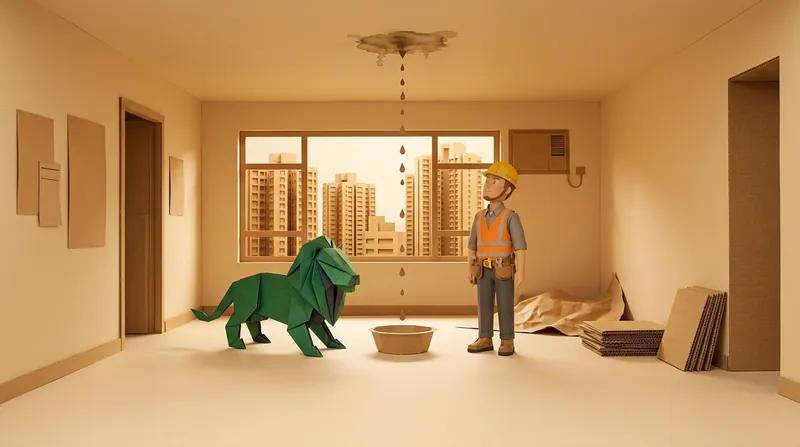
One of the most common renovation disputes: you're mid-renovation, and two days in, there's a knock from downstairs — the ceiling is leaking, and they suspect you've burst a pipe. This guide is written for both sides at once, because the two situations often end up in the same place: the Small Claims Tribunal.
This guide draws on public materials from the Hong Kong Judiciary, the Joint Office for Investigation of Water Seepage, the Buildings Department, the Consumer Council and CLIC to lay out who's liable, whether the Joint Office can actually help, and what evidence each side needs.
Who's Liable When Renovation Causes a Leak Downstairs?
Honestly, no government department or the Judiciary states this in black and white — we couldn't find a single provision that specifically says "a private flat owner whose renovation bursts a pipe must compensate the downstairs neighbour." Does that mean downstairs is out of luck? Not at all. There's a basic common-law proposition that applies in most renovation-damage cases: you paid to have work done on your own property, commissioned and directed by you, so if it goes wrong and damages the flat downstairs, the first person downstairs will generally look to is you, the owner. Whether the contractor did something wrong is a separate question from whether downstairs can recover from you (more on that next).
This is a general common-law proposition, not a citation to any government provision. Set against it, one document does state in black and white that an owner must compensate, but its scope is narrow: the Housing Authority's guidelines for decoration contractors state that in HOS, Green Form and public rental flats, removing floor tiles or moving partition walls can destroy the waterproofing membrane, and the flat owner must compensate the affected households — a contractual term between the Housing Authority and the owner, applying only to subsidised housing, not a law across private buildings. Separately, the Judiciary's Small Claims Tribunal FAQ confirms a victim may claim against the tortfeasor for nuisance or property damage from seepage — that confirms the method of recovery, but not who the tortfeasor is; that comes down to the facts of the case and, at the Tribunal, the adjudicator's own finding.
This also explains why "wait for the Joint Office to rule first" is a poor strategy here — the Joint Office may not even take the case on (next section), and a neighbour who waits for a ruling that never comes is just waiting for nothing.
Your Claim Against the Contractor Is a Separate Case
If you're the owner mid-renovation, you might be thinking: "So I'm on the hook for everything? My contractor's the one who burst the pipe!" Here's the distinction: downstairs claiming against you and you claiming against your contractor are two entirely separate cases. Downstairs only needs to show the damage relates to your renovation work; whether your contractor was negligent is the substance of a separate indemnity claim you bring yourself — you pay downstairs first, then use the contract, quotation and correspondence to go after the contractor, proving they breached the contract terms or failed industry-standard workmanship.
This is worth thinking through before work even starts. The Consumer Council has pointed out that a consumer should clarify which side is responsible for third-party liability or home renovation insurance — yet most contractors' quotations set out terms only vaguely or not at all, leaving owners badly placed exactly when they need it. If something has already gone wrong, your claim runs against the contractor, not downstairs; see our guide to contractor disputes. Recovering from your contractor requires its own evidence: the contract and quotation, photos from during the works, correspondence, and the receipts for what you paid downstairs.
What the Downstairs Neighbour Needs to Stand On
If you're the neighbour whose flat is taking on water, what you need on hand lines up with the Tribunal's "balance of probabilities" standard — not an official conclusion, but an evidence chain that holds together. Four elements are essential:
- Dated photos and video: from the moment you first notice the stain, photograph it at the same angle and position regularly, to show how it's progressing.
- A timeline matching the upstairs renovation dates: when the works started and finished, set against when you first noticed the seepage — the tighter the fit, the more persuasive.
- Itemised quotations for each piece of damage: wall refinishing, furniture, cleaning, quoted separately rather than lumped into one total.
- A finding on the source, where disputed: a Joint Office investigation record, or a private assessment from an independent surveyor or plumber.
Of these, the timeline is what people most often miss — plenty go straight to getting it fixed without noting when the upstairs renovation started and finished, only to find, once it's time to file, that all they have is a pile of undated photos. If you know there's renovation upstairs, start recording the approximate dates as soon as the stain appears.

This site carries an illustrative case, Three Years of an Unrepaired Ceiling Leak — Repair Costs Recovered After Filing — a tenant-landlord dispute rather than a renovation one, but the approach is worth applying: the claimant organised three years of dated photos and messages into a clear timeline, split the loss into separate itemised quotations, and recovered HK$18,500. What mattered wasn't how bad the situation was — it's how scattered evidence became a document an adjudicator could follow.
The Joint Office Likely Can't Help With This Kind of Leak
Most downstairs neighbours' first instinct is to call 1823 and get the Joint Office for Investigation of Water Seepage involved — that instinct isn't wrong, but be prepared: per the Joint Office's own materials, seepage caused by rain entering through roofs, external walls or windows, and seepage caused by damaged or burst water supply pipes, does not normally constitute a public-health nuisance, and the Joint Office will not invoke the Public Health and Municipal Services Ordinance (Cap. 132) to take enforcement action over it. A typical "renovation burst a pipe" case very likely falls outside its enforcement remit from the outset — the civil route may be your only path.
Even in a case it does take on, its role is limited to enforcing Cap. 132 to abate the nuisance. The Buildings Department's materials put it plainly: the Joint Office does not take part in repairing the affected area, and it awards no compensation; the official advice is to engage a building professional or legal adviser and require the responsible party under the Deed of Mutual Covenant to stop the seepage, or pursue a damages claim.
So should you still call 1823? Yes, but adjust your expectations — even if the Joint Office says the case falls outside its remit, you'll still have a preliminary investigation record, itself part of the "timeline" evidence above, and it can run in parallel with a civil claim.
Both Sides Can End Up at the Small Claims Tribunal
Whether you're the renovating owner or the downstairs neighbour, if the money at stake is within HK$75,000, both of you may end up at the Small Claims Tribunal. Per the Hong Kong Judiciary, the Tribunal's jurisdiction (Cap. 338, s.5) expressly covers claims arising from contract, quasi-contract and tort, including damage to property — wall, furniture and flooring damage from seepage falls squarely into that category. Hearings are conducted informally, with no legal representation allowed on either side, and even if you win, any solicitor's fees you personally paid cannot be recovered.
Filing fees scale with the amount claimed — over HK$5,000 up to HK$25,000 costs HK$40; over HK$25,000 to HK$50,000 costs HK$70; over HK$50,000 to HK$75,000 costs HK$120 (fee schedule). A claim exceeding the ceiling may not be split into multiple claims, but you may abandon the amount exceeding HK$75,000 to bring it within the limit. On limitation, per CLIC, a contract claim must start within 6 years of the breach; personal injury carries a shorter 3-year limit — evidence erodes over time, so this is worth keeping in mind either way.
See our complete guide to water-damage claims for jurisdiction details, or our filing assistance service if you have evidence but need help turning it into a statement. Everything we handle on water seepage claims sits on that one page.

If You're in an HOS or Public Rental Flat
As noted above, there's no explicit law on this for private flats — but if your flat is under the Home Ownership Scheme, Green Form Scheme, or public rental housing, the position differs. Per the Housing Authority's guidelines, removing floor tiles or moving partition walls can destroy the waterproofing membrane, and the flat owner must compensate the affected households — stated in black and white in a Housing Authority document, unlike the general private-flat proposition.
The same document also states the Housing Authority bears no responsibility for disputes between the contractor and the household — it governs only "the owner must compensate downstairs," not how the owner and contractor split the bill between themselves; that remains separate (the indemnity claim above). This document is useful leverage in negotiation, but it's a contractor-registration standard, not a provision you can cite directly at the Tribunal — proving liability still comes down to the same dated photos, timeline and itemised quotations covered above.
Frequently Asked Questions
This is very common. Downstairs claiming against you doesn't require your contractor to admit fault — they only need to prove the damage relates to your renovation work. Whether your contractor is actually at fault is a separate matter you can pursue after paying downstairs, using the contract and construction records. Keep the two matters apart.
No. The Joint Office's role is to enforce Cap. 132 to abate a nuisance; it does not award compensation and does not take part in repairs. Even if your case falls outside its remit, you can still pursue a civil claim at the Small Claims Tribunal or another court — the two are entirely independent.
The Small Claims Tribunal procedure allows either side to file a claim of up to HK$75,000 without first settling by agreement. That said, talking things through before filing usually saves both sides time; if it doesn't work out, filing afterwards is never too late.
Start preserving evidence first — dated photos and video, a timeline matching the upstairs renovation dates, and itemised repair quotations. You can commission an independent assessment and call 1823 for a preliminary Joint Office investigation, but be prepared that if the source is a damaged water pipe, the Joint Office may not follow through to a conclusion.
Yes — a separate claim with its own limitation period, generally 6 years from the breach. You need the renovation contract, quotation, construction photos and correspondence to show the workmanship was defective. Paying downstairs doesn't automatically establish contractor liability; you still have to prove that yourself.
A Deed of Mutual Covenant mainly governs rights and responsibilities between owners over common areas. A downstairs neighbour pursuing an owner usually relies on the common-law proposition covered above, not the Deed — if renovation work you commissioned damaged someone else's flat, you're generally the first person who has to answer for it.
EasyDebt is not a law firm. This article is general procedural information only, not legal advice. Individual cases depend on Hong Kong law and the Tribunal's ruling.
Further Reading
This article is for general reference only and does not constitute legal advice. We are not a law firm; please evaluate your individual case based on specific circumstances.