Landlord Changed the Locks or Threw Out Your Belongings Without a Court Order? Claiming in Hong Kong

EasyDebt Editorial
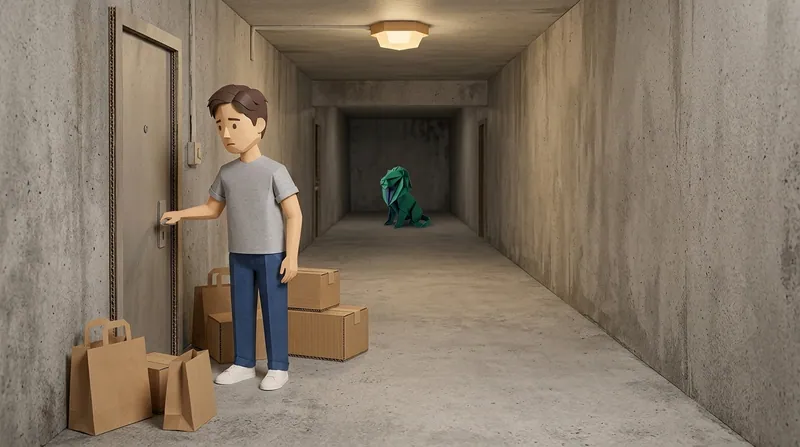
You get home and your key won't turn in the lock. Or you go downstairs and find your belongings already piled up in the corridor — maybe the water and power have been cut too. Your first thought might be, "I know I'm behind on rent, this is on me." This article exists to say clearly: a landlord who evicts you this way may have broken the law themselves, whether or not you genuinely owe rent.
This isn't about how a landlord should lawfully recover unpaid rent — that side is covered in Rent in Arrears: A Hong Kong Landlord's Guide and Dealing with a Rent Defaulter in Hong Kong: What to Do, in Order. This article stands on your side — the tenant's — where your landlord skipped the court process entirely and evicted you directly, and what you can do about it.
It's worth saying plainly: feeling embarrassed about the arrears is a completely different question from whether the landlord's own response was lawful. Plenty of tenants in this position stay quiet precisely because they think being behind on rent means they've forfeited any right to complain — that isn't how the law actually works, and the rest of this guide explains why.
Changing locks, cutting utilities: a criminal offence even if you owe rent
Start with the core point: a landlord who wants to recover a unit cannot simply decide to do so — they need a court or tribunal order first.
Per the Rating and Valuation Department's official guide to the Landlord and Tenant (Consolidation) Ordinance (Cap. 7), any person who, without a court order, attempts to intimidate, use violence, withhold services (such as cutting off water, electricity or gas), or use any other form of interference to force a tenant or sub-tenant to vacate commits a criminal offence — this protection extends to sub-tenants too. A first conviction can carry a fine of HK$500,000 and imprisonment for 12 months; a repeat conviction, a fine of HK$1,000,000 and imprisonment for 3 years. Beyond the criminal penalty, the court can also order the landlord to pay compensation to the former tenant or sub-tenant, and can separately order forfeiture of a sum up to the difference between the unit's vacant-possession market value and its value while occupied by the former tenant.
Note that the official description of this offence carries no exception for a tenant who genuinely owes rent. In other words, even if you accept you're behind on payments, the landlord still has no right to act unilaterally — they must go through the court process to lawfully recover the unit. This is counter-intuitive for many landlords and tenants alike: it's easy to assume that "the tenant really does owe money" automatically means the landlord "has the right" to act directly. But the law isn't asking who has the better argument — it's asking whether the landlord followed the required procedure.

What a landlord should actually do: the lawful route to possession
So what lawful options does a landlord actually have to recover a unit or pursue arrears? Understanding this tells you whether your landlord has already cut a corner.
Per the same RVD guide, where a tenant is in arrears, a landlord's lawful options are:
- Apply to the District Court for a writ of distress — a bailiff seizes the tenant's movable property in the premises and sells it to recover the arrears if unpaid (not available for arrears over 12 months);
- Pursue the arrears at the Small Claims Tribunal or District Court — claims up to HK$75,000 go to the Small Claims Tribunal, above that to the District Court;
- Apply to the Lands Tribunal for a possession order — this is the actual lawful route to recovering the unit itself.
Even where a tenant refuses to move out after a tenancy has ended, a landlord must still obtain an order from the Lands Tribunal or another court before recovering possession — the guide states this plainly. None of these three routes involves the landlord personally changing locks, removing belongings, or cutting utilities. If your landlord skipped these steps and acted directly, the step they skipped is exactly the offence covered above.
Your own civil claim: property loss and other losses
Beyond a potential criminal offence on the landlord's side, you as the tenant have a separate civil claim of your own — one that can proceed alongside any criminal complaint, not instead of it.
The logic is simple: the landlord breaking the law doesn't automatically put money back in your pocket — you still need to actively pursue your own loss. What can typically be claimed includes:
- Belongings discarded or damaged — the actual value or repair cost of furniture, appliances, clothing and similar items;
- Emergency accommodation costs caused by the sudden eviction — the actual cost of a hotel or short-term rental while displaced;
- Other documented, direct losses caused by the incident.
This falls under a property-damage type claim, and per the RVD guide, the Small Claims Tribunal's jurisdiction explicitly covers exactly this kind of claim, up to HK$75,000, handled informally and without lawyers, at a relatively low cost (for the full filing process, see The Complete Guide to the Small Claims Tribunal). To make the claim hold up, keep every piece of evidence — the landlord's messages, the date and time the lock was changed or utilities cut, photos or purchase records of your belongings, and accommodation receipts (for how to prepare evidence properly, see Preparing Evidence and Documents). EasyDebt has handled a rent-arrears recovery case, and the same lesson applies here: complete records and a clear timeline are what let an adjudicator actually follow your account of events.
A few practical habits make a real difference here. If you can still get back into the corridor or building, photograph the changed lock and anything left outside before you move or tidy anything — a tidy pile photographed the next day is far less convincing than a photo taken on the spot. Where possible, list your discarded belongings item by item rather than as a lump-sum estimate, noting roughly when and for how much each was bought if you still have receipts, a bank or card statement, or even an online order history; a tribunal generally responds better to an itemised list it can check against something than to a single round figure. If you had to move into a hotel or a short-term rental in the days immediately after, keep the actual receipt or booking confirmation rather than reconstructing the cost from memory later.

How to complain about a landlord
The criminal side of this isn't something you file yourself — it goes to the department responsible for enforcing the ordinance.
Per the RVD's own complaints guidance, if you suspect a landlord has breached the Landlord and Tenant (Consolidation) Ordinance, you can complain in writing, in person, by email, fax or phone. The Department will first make enquiries and gather information from you, may conduct a site inspection, and where a suspected offence under the Ordinance is involved, will seek legal advice from the Department of Justice and consider legal action. Because changing locks or cutting utilities can itself be a criminal offence, it's generally advisable to also file a police report in parallel, so there's an additional official record of what happened.
Note that a complaint and a civil claim are two separate things — a complaint to the RVD is about whether the landlord gets prosecuted, and won't by itself get you compensation for discarded belongings. To recover your own losses, you still need the Small Claims Tribunal route above. For a broader look at where your situation fits and how to follow through, see EasyDebt's collected rent-arrears cases.
A note to landlords reading this
If you're a landlord reading this far: the penalties and criminal liability described above are not exaggerated. Even if you have every reason on your side — the tenant genuinely is months behind — it isn't worth trading a few days' head start for a criminal record and a compensation order.
The right route is the one described above: pursue the arrears, apply for a writ of distress, or apply to the Lands Tribunal for a possession order. For the lawful, effective way to recover arrears, see Rent in Arrears: A Hong Kong Landlord's Guide and Dealing with a Rent Defaulter in Hong Kong: What to Do, in Order — those two are written for landlords.
FAQ
Correct. Per the Rating and Valuation Department's guidance, attempting to evict a tenant by changing locks, cutting utilities or similar means without a court order is itself a criminal offence, regardless of whether the tenant is in arrears. The landlord must still go through the court or tribunal to lawfully recover the unit.
Generally, you can claim the actual value or repair cost of the belongings, emergency accommodation costs caused by the sudden eviction, and other documented, direct losses from the incident. For sums of HK$75,000 or under, this can be pursued at the Small Claims Tribunal.
No. A complaint to the Department addresses whether the landlord broke the law and may be prosecuted — a criminal matter. To recover compensation for your own losses, you need to separately file a civil claim at the Small Claims Tribunal; the two are handled separately.
Since changing locks or cutting utilities can itself constitute a criminal offence, it's generally advisable to also file a police report, so there's an official record of what happened that can support both your complaint and your claim.
EasyDebt is not a law firm. This article is for general procedural reference only and does not constitute legal advice. Individual cases are subject to Hong Kong law and the tribunal's ruling.
Further Reading
This article is for general reference only and does not constitute legal advice. We are not a law firm; please evaluate your individual case based on specific circumstances.