A Burst Pipe Upstairs Flooded Your Flat? Sudden Bursts Are a Different Claim from a Slow Leak

EasyDebt Editorial
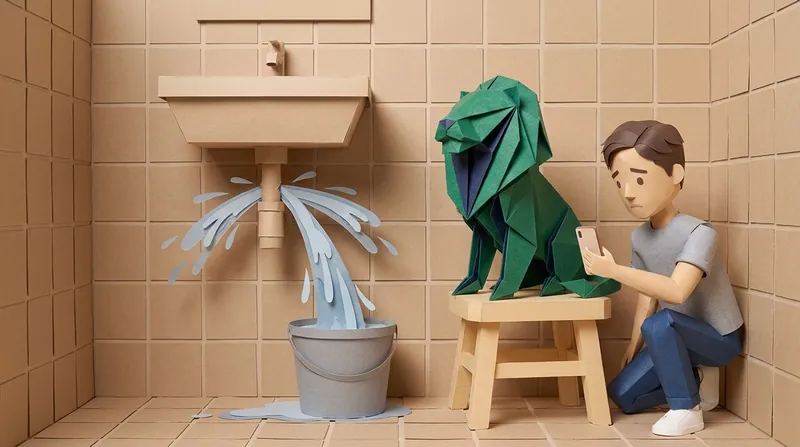
A washing-machine hose suddenly bursts, a toilet cistern connection splits open, a supply pipe joint gives way with a bang and sprays water everywhere — this kind of sudden, accidental burst is a genuinely different problem from a ceiling that has been slowly seeping for weeks. Yet most people's first instinct is still to call the Joint Office for Investigation of Water Seepage, only to find out days later that this type of case isn't actually theirs to take.
This guide draws on public materials from the Food and Environmental Hygiene Department, the Hong Kong Judiciary and local news reporting to explain why a sudden burst needs a completely different approach — what evidence to capture on the spot, how liability actually gets decided, and where to file to recover your loss. If you'd like the general water-damage claim process first, see our complete guide to water-damage claims; if you already hold home insurance, our guide on choosing between an insurance claim and a Tribunal claim is also worth reading.
Sudden Burst vs a Slow Leak: Why They Need Different Handling
A ceiling stain that slowly spreads, a wall that gradually grows mould — for that kind of gradual seepage, you often genuinely don't know the source at first, so you need the Joint Office, a timeline, and moisture records to piece the evidence together (see our guide on what to do when the Joint Office can't find the source).
A sudden burst is nothing like that. By the time you notice it, the source is usually obvious — which pipe, which joint, when it started — and it may already have stopped spraying (because you or the unit upstairs shut off the main valve). The evidence priorities are therefore completely different:
- Photograph and film it while it's happening: capture the water actively spraying, not the wall after it has already dried — "spraying right now" and "already dry" carry very different weight as evidence.
- Get a plumber to look at it the same day: a written assessment stating exactly which pipe failed and why is far more persuasive than a recollection of "roughly where it burst" after the fact.
- Log an accurate timeline: what time you discovered it, what time you notified whom (management, the upstairs owner), what time it was actually dealt with — this timeline is often itself the key to deciding liability (more on this below, under "Who Is Liable").
Why the Joint Office Usually Can't Help
This is the part that leaves the most people waiting for nothing.
Per the Food and Environmental Hygiene Department's own published FAQ, seepage caused by a broken supply pipe generally does not constitute a public health nuisance under the Public Health and Municipal Services Ordinance (Cap. 132). In other words, if the Joint Office for Investigation of Water Seepage confirms the source is a burst supply pipe, it will not invoke Cap. 132 to take enforcement action on that case.
The logic behind this: the Joint Office's statutory role is to deal with ongoing nuisances — the slow, hard-to-pin-down kind — not a one-off accident that has already happened and finished. Your pipe has already burst, the water has already stopped spraying; that's already a settled fact, not "an ongoing sanitary problem" requiring an investigation into an unclear source.
That means recovering this kind of loss is, from start to finish, your own civil claim — it has essentially nothing to do with the Joint Office's government-investigation track. You don't need to wait for them to inspect anything or produce a report; instead, you should immediately gather your own evidence, get a plumber's assessment, and pursue the responsible party directly.
Who Is Liable? An Accident vs Ignored Warning Signs
There's no one-size-fits-all answer here — it depends on what actually caused the burst. Two real Hong Kong cases illustrate the distinction well.
In the first, a burst pipe at the water-meter connection point of a private housing unit dragged the building's elevator down with it, with repair costs running to nearly a million dollars. A lawyer who later reviewed the case concluded the owner wasn't actually liable — she had notified management the moment she found the problem, but management took roughly an hour to confirm which unit the pipe belonged to, and initially just mopped up the water without shutting off the main valve, which is what let the damage escalate. (See the full report for the details.)
The second was more serious: a toilet cistern's supply pipe burst on the fourth floor of a single-block building in Tai Kok Tsui, running for roughly 8 hours (from midday into the evening). Water flooded 3 floors and an elevator; the flat below had its entrance, ceiling, false ceiling and flooring all soaked and damaged, and when the resident switched on a light, water tracking along the wiring caused a short circuit that later inspection confirmed had burned the wires. A senior surveyor said that if the elevator suffered further water damage, the claim could reach seven figures, with the downstairs unit's own repair costs conservatively estimated at six figures already. (See the incident report.)
A barrister interviewed about that second case, Luk Wai-hung, laid out how liability actually gets decided by cause:
| Cause of the burst | Who is generally liable |
|---|---|
| A structural issue such as an ageing pipe | Usually the owner |
| Misuse or damage by a tenant (e.g. breaking the cistern themselves) | Usually the tenant |
| The cause can't be determined | The safe approach is naming the owner as first defendant and the tenant as second, and suing both |
The barrister specifically noted that suing both parties avoids the risk of a claim being dismissed for "naming the wrong defendant" — with costs consequences to match — and that even if the tenant later disappears or refuses to cooperate, the owner remains liable; a court can even order the property registered as a charge, or garnish future rental income.
This is, in fact, the same logic as our guide to water-damage claims, where liability turns on whether the owner "knew and delayed" — even for a sudden accident, if the burst came from a pipe everyone already knew was ageing, or that had shown warning signs before, failing to act on that can still amount to negligence. One of our own case studies, a ceiling-leak claim recovered after three years, involves a different kind of ongoing leak, but the principle carries over: what an adjudicator actually looks at is whether you can produce a record showing the other party knew, or should have known — not who tells the better story.
How Home Insurance Can Help
If you're the victim (the downstairs flat), it's worth checking whether the source unit's home insurance includes "third-party liability" cover — this doesn't cover the source unit's own loss, it covers the source unit's legal liability to pay a third party (you).
As one example, OneDegree's home insurance includes third-party liability cover of up to HK$15 million, covering the legal compensation liability arising when a home leak or flood damages a neighbour's unit (including ceiling seepage, or even shared building facilities like an elevator). This HK$15 million figure is that particular insurance product's own level of cover — it is not a uniform standard across Hong Kong's home insurance industry; cover amounts vary widely between policies, and some carry no such cover at all.
In practice, if you find the source is the unit upstairs, it's worth asking early for their home insurer's details, because some insurers will negotiate a settlement directly with the affected party without needing to wait for a Tribunal hearing. That said, this always depends on whether the other side actually has cover and how much — you can't assume everyone is insured. Without insurance, or with insufficient cover, you still pursue the source unit's owner (or, per the analysis above, the tenant) directly.
Valuing Your Claim
A claim for a sudden pipe burst is generally made up of the following:
- Repair and restoration costs: an actual repair quotation for the wall, ceiling and floor, ideally a written quote from an independent contractor rather than one lump-sum figure.
- Compensation for damaged property: furniture, appliances and other items ruined by water, valued at replacement cost less a reasonable allowance for wear and depreciation — a five-year-old piece of furniture shouldn't be priced as brand new.
- Emergency mitigation costs: receipts for an emergency plumber called to stop the water, or a dehumidifying company — this kind of "stop the loss immediately" spending is generally recoverable too.
- Possible consequential loss: for example an appliance replaced because it short-circuited from water ingress, provided you have an inspection report proving the causal link (as in the 8-hour saltwater-flood case above, where a post-incident inspection confirmed the wiring had burned out).
Whichever item it is, keep them itemised separately with independent receipts or quotations attached — this approach has repeatedly proven effective across our published case studies: a broken-down, itemised loss is far more persuasive than one vague total.

Small Claims Tribunal or District Court?
This step comes down purely to the amount. Per the Hong Kong Judiciary, the Small Claims Tribunal's ceiling is HK$75,000. If your loss (repairs, damaged property, emergency costs, all combined) sits at or below that ceiling, you can use the Small Claims Tribunal's simpler route — filing fees run from HK$20 to HK$120, and legal representation generally isn't required.
But as the Tai Kok Tsui toilet-cistern case above shows, once a loss (especially one involving elevator or structural repairs) exceeds HK$75,000, the case moves to the District Court instead, with an entirely different procedure, cost structure and timeline from the Tribunal — it's generally worth getting legal advice first.
If you'd like someone to walk the whole process with you, see what our filing assistance service actually covers, or browse more on how a water-leakage claim plays out in practice. Before filing, our complete guide to preparing evidence still applies to a sudden burst — the only difference is that what you need to capture is the moment water is actively spraying, not a stain that has been slowly spreading.
Frequently Asked Questions
If the situation is genuinely urgent — an electrical hazard, a ceiling at risk of collapse, flooding that threatens public safety — call the police or 999 immediately. This guide covers the civil claims process that comes afterwards; it doesn't replace any emergency response.
Yes. Whether the other party is liable and whether they've also suffered a loss are two separate questions — even if the upstairs unit also needs repairs, that doesn't mean they bear no responsibility for your loss. As above, what matters is the cause of the burst (structural ageing vs misuse) and whether they dealt with it promptly once notified.
Not strictly, but it's strongly recommended. The Small Claims Tribunal applies the civil "balance of probabilities" standard, so in theory a timeline, photos and correspondence can help too — but a professional assessment report stating the cause is usually far more persuasive than a description based on the naked eye alone.
You can enquire through the building's management office or Owners' Corporation, or engage a filing-assistance service to help verify ownership through a land search. If the claim ultimately can't be served on the defendant, the Tribunal will ask you to provide a correct address, and if service keeps failing the case can't proceed any further — so verifying the other party's identity and address is a step worth doing early, not later.
EasyDebt is not a law firm. This article is general procedural information only, not legal advice. Individual cases depend on Hong Kong law and the Tribunal's ruling.
Further Reading
This article is for general reference only and does not constitute legal advice. We are not a law firm; please evaluate your individual case based on specific circumstances.