Who Pays When Concrete Falls? Spalling-Concrete Liability in Hong Kong

EasyDebt Editorial

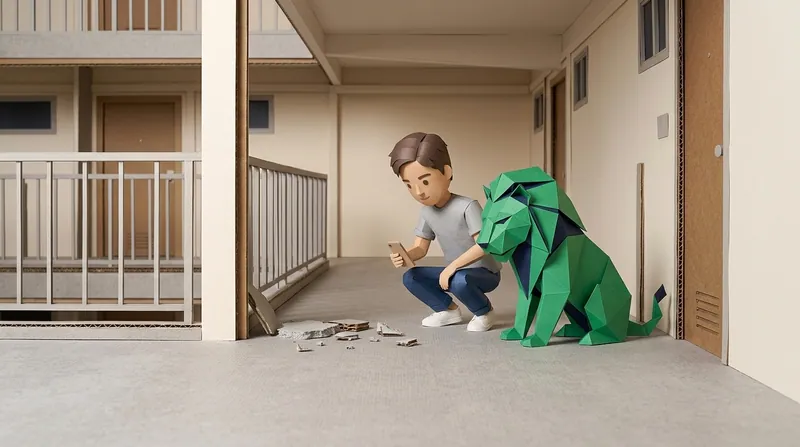
Hong Kong has no shortage of older buildings, and spalling concrete — pieces of concrete cracking and falling away from a ceiling, facade or beam — is something almost anyone who has lived in one has seen, or heard about. The frustrating part is that what falls often does real damage: a parked car's windshield cracked by a chunk of concrete, a balcony air-conditioner unit smashed, or worse. This article isn't about the engineering side of building safety — it's about a much more practical question: when spalling concrete damages something, who actually pays, and how do you get the money back?
Before anything else, one thing has to be clear: liability for spalling concrete is never a blanket "the owner" or "the Owners' Corporation" answer — it depends on exactly where the spalling occurred. The logic here runs parallel to how liability works for a common-area pipe leak — same building, similar phenomenon, but a completely different party to pursue depending on the source.
Concrete Damaged Your Car or Property? Start by Identifying Who Is Liable
The single most important point first: responsibility for spalling concrete turns on location, not on who happened to be affected. Within the same building, there are at least three distinct scenarios:
- Inside a private unit's own boundary — spalling within a unit's own structure or fit-out (a balcony ceiling, an internal wall) is generally the owner's own maintenance responsibility.
- Connected to an upstairs unit — where spalling is caused by moisture from an upstairs unit's renovation, drilling or plumbing issue, the situation resembles a water-leakage claim — a shared responsibility question that depends on the actual source and causation.
- True common parts — spalling on the building's external facade, a common corridor ceiling, a stairwell or a car park ceiling is the Owners' Corporation's responsibility, a position the Building Management Ordinance (Cap. 344) sets out clearly.
This article focuses on that third scenario: spalling concrete on the common parts damaging a vehicle or other property, and how to actually recover the cost.
Private Unit or Common Parts: Liability Differs Completely
Why does pinning down the exact location matter so much? Because it decides who you should approach, and through which mechanism.
If the damage originates from the common parts, the first move isn't drafting a filing — it's contacting the Owners' Corporation, or the building management company it has appointed. According to the Community Legal Information Centre (CLIC), one of an Owners' Corporation's core statutory functions is overseeing the services the building manager provides and the budget spent on management and maintenance work; once formed, the building manager becomes answerable to the Corporation, which also has the power to terminate the manager's appointment. In other words, upkeep of the common parts — including the external facade and common corridor ceilings — has, in principle, always sat within the Corporation's oversight. Whether the Corporation had already been made aware of a known spalling risk and failed to act on it is often the key fact in any later claim discussion.
To be honest, though, the line isn't always this clean in practice. The cause of spalling in an older building can be corrosion of embedded reinforcement, years of accumulated water ingress, or something intertwined with a unit's own renovation work — and telling which is which usually needs an independent building survey. If the sum involved isn't trivial (repairing or replacing a car, for instance), the cost of an independent assessment is usually worth paying. If the dispute turns into a separate argument with a repair contractor (over a quote or the quality of the work), see how we approach repair-dispute cases.

The Owners' Corporation's Third-Party Risk Insurance: Getting Paid
Once you've established that the spalling happened on the common parts, the next practical step is checking whether the Owners' Corporation carries third-party risk insurance, and how to make a claim against it.
Under Building Management Ordinance (Cap. 344) s.28 and the Building Management (Third Party Risk Insurance) Regulation, which took effect on 1 January 2011, the Home Affairs Department's LegCo reply on the topic confirms that an Owners' Corporation must take out and keep in force third-party risk insurance covering the common parts of the building and the Corporation's own property, with a minimum coverage of HK$10 million per incident. This isn't an optional arrangement — it's a statutory obligation on the Corporation — so if spalling concrete on the common parts has damaged your car or other property, the first thing worth doing is writing (email or letter) to the Corporation or the management office to ask:
- Whether the incident location is confirmed to be on the common parts
- Whether the Corporation holds third-party risk insurance for this kind of incident, and the policy number and insurer's contact details
- The formal channel and documents required to submit a claim
Note that claiming against the Corporation's insurer is a different process from filing directly at the Small Claims Tribunal — an insurance claim is usually faster, but the insurer will still assess it against its own policy terms and may not pay the full amount. If the insurer declines, or the Corporation simply doesn't follow up, that's when the Tribunal route against the Corporation or another responsible party becomes the next step.
Mandatory Building Inspection: Why Older Buildings Are Higher Risk
Most people have heard of the "Mandatory Building Inspection Scheme," but aren't sure how it connects to a compensation claim. In short: the two are related but distinct — understanding the framework just helps you judge how much risk a given building carries.
According to the Buildings Department, the Mandatory Building Inspection Scheme applies to private buildings aged 30 years or older (excluding domestic buildings not exceeding 3 storeys). Once an owner receives a statutory notice from the Buildings Department, they must appoint a Registered Inspector to carry out prescribed inspections of the common areas, external walls, and projections or signboards; where the inspection finds that prescribed repairs are needed, a Registered Contractor must then be appointed to carry out the work under the Registered Inspector's supervision.
This scheme exists for structural safety and is preventive in nature — which means a building already under an inspection notice, or one that has already completed an inspection, doesn't automatically mean past damage was already someone's responsibility, and a building that hasn't received a notice yet isn't necessarily safe either. Put differently: the Mandatory Building Inspection Scheme is a structural-safety framework running on a separate track from your money claim over a spalling incident that has already happened — but if your building is well into that 30-year-plus range, it's useful context for judging whether the Corporation has a reasonable excuse for claiming it "didn't know."
Preparing Evidence and Where to Actually File
Whether you end up claiming against the Corporation's insurer or filing formally, evidence is what decides the outcome (see our full guide to preparing evidence for the detail). For a spalling-concrete case, try to keep:
- Photos and video of the scene — the fallen debris itself, the damage (e.g. cracks in a car windscreen), with the time and location as clear as possible
- A repair or replacement quotation for the damage — at least one independent quote, to help set the claim amount
- A record of written notifications — emails, letters or WhatsApp messages to the Corporation or management office, including their replies (or the dates when they didn't reply)
- Insurance-related documents — if the Corporation's insurer has started handling it, keep the claim reference, correspondence and any decision
If the Corporation or the insurer keeps stalling, refuses to follow up, or offers a settlement well short of your actual loss, a money claim for damage to a vehicle or other property can go through the Small Claims Tribunal. According to the Hong Kong Judiciary, the Tribunal explicitly handles property-damage claims, with a jurisdiction ceiling of HK$75,000; claims cannot be artificially split to stay under that limit, though if your loss slightly exceeds it, you can choose to abandon the excess to stay within the Tribunal's jurisdiction. For the actual filing process and form details, see our full guide to the Small Claims Tribunal and our guide to completing the claim form. Note that this article doesn't cover personal injury claims, or claims above HK$75,000 where you're unwilling to abandon the excess — those need a different court route.
If you'd rather not work through checking the policy, writing letters and completing the filing forms alone, our filing assistance service can walk with you from gathering evidence through to the hearing.
Frequently Asked Questions
Not strictly, in theory — but in practice, sending a written request to the Corporation or management office first helps confirm whether the incident happened on the common parts and what the Corporation's insurance actually covers, and sometimes resolves it through insurance without ever needing to file. If the Corporation ignores you, that written record itself becomes important evidence for a later filing.
Consider commissioning an independent assessment (for example from a Registered Inspector or another relevant professional) to produce a written opinion. If the amount at stake isn't small, that assessment fee is usually a worthwhile investment, since it's what actually determines who you should be pursuing.
If the Corporation had a known maintenance risk it failed to act on, or the insurance payout falls well short of the actual loss, you can consider pursuing the shortfall directly against the Corporation through the Small Claims Tribunal (capped at HK$75,000). Whether that succeeds depends on the evidence and causation in your specific case, so it's worth organising your material carefully first.
Yes, though the exact limitation period depends on the nature of the claim rather than a single fixed number of years. To be safe, act promptly rather than risk missing your window through delay.
EasyDebt is not a law firm. This article is for general procedural information only and does not constitute legal advice. Individual cases are subject to Hong Kong law and the Tribunal's rulings.
Further Reading
This article is for general reference only and does not constitute legal advice. We are not a law firm; please evaluate your individual case based on specific circumstances.