Leak From a Common-Area Pipe? Who Pays — the Owners' Corporation or a Neighbour

EasyDebt Editorial
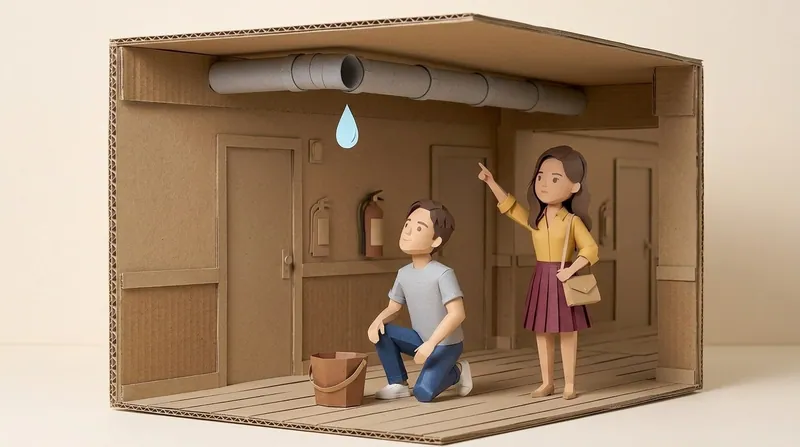
The first instinct when a ceiling leaks is to blame the unit upstairs — but if the upstairs owner insists it's "nothing to do with them", or the flat above is actually vacant, or you simply can't trace a source there no matter how hard you look, there's a good chance the water isn't coming from a private unit at all. It may be coming from the building's common areas: the roof, an external wall, a corridor ceiling, or pipework that serves more than one unit. In that case, the party to pursue is completely different from a typical upstairs-leak dispute — not a neighbour, but the Owners' Corporation.
This article explains how to tell whether a leak's source is common-area, what the Owners' Corporation is legally responsible for, what to do when it stalls, and how to pursue a claim at the Small Claims Tribunal if negotiation fails. If you've already traced your leak to a private unit above, see the guide to upstairs water leakage claims instead — that one covers a private-unit-to-private-unit dispute, which is a different situation from this one.
Common-Area Leak or a Leak From the Unit Above? How to Tell the Difference
Identifying the source is the first step, and it decides who you should actually be pursuing — chase the wrong party and you don't just waste time, you may have to start over.
Which locations count as "common areas"?
Leaks caused by pipework or structural issues in the following locations are generally treated as common-area matters:
- Roof and platforms — deteriorated waterproofing, or blocked roof drains and pipework
- External walls — cracked render or brickwork letting water into the flat
- Corridor and staircase ceilings — these are common areas by definition
- Shared pipework serving more than one unit — a shared drainage stack or fire-service pipe running through multiple floors, as distinct from pipework that serves only a single private unit
By contrast, if the source is the upstairs unit's own kitchen or bathroom pipework, an air-conditioner condensate pipe, or a private renovation gone wrong, that's a private-unit-to-private-unit civil dispute — the party to pursue is that upstairs owner, not the corporation.
How do you actually find out where the leak is coming from?
Visual inspection alone often can't confirm the source. The safer route is to report it to the Joint Office for Investigation of Water Seepage Complaints (call "1823" or submit online) — Buildings Department and Food and Environmental Hygiene Department staff will inspect the site and use equipment to pinpoint the source. Among the cases the Joint Office handles, rainwater seepage from the roof, a platform, external wall or window, and seepage caused by damaged supply pipes, generally don't amount to a public health nuisance on their own; but where the suspected source is a building common area, the Joint Office will advise the Owners' Corporation to hire a building professional to inspect and arrange repairs. That matters — it means even the official process treats the corporation, not an individual owner, as the party to follow up with.
Who Is Liable — the Owners' Corporation or the Management Company?
Many owners assume that maintaining common areas is "the management company's job" and has nothing to do with the corporation. Legally, that's not quite right, and the division of roles is worth getting straight.
Which one actually carries the legal responsibility?
An Owners' Corporation is an independent legal entity formed under the Building Management Ordinance (Cap. 344) that legally represents all owners in managing the building's common parts; resolutions passed at the corporation's general meeting on the control, management, administration and improvement of common areas are binding on the management committee and every owner. In other words, when a common area leaks, the party legally responsible is the corporation — not an individual owner, and not the neighbour next door.
In practice, a corporation usually hires a property management company (the "manager") to carry out day-to-day repair work. Under the Building Management Ordinance, the corporation is empowered to supervise the manager's services and repair budget — the manager's duties include repairing and maintaining the building's common areas and keeping them clean, while the corporation's role is supervisory, not operational, and it can terminate the manager's appointment for poor performance. So even though day-to-day repairs are usually handled by the management company, the ultimate legal responsibility — and the party to pursue — remains the corporation itself.
So should you sue the corporation, or the management company?
As a general rule, pursue the corporation, not the management company — unless there's clear evidence the management company itself was independently negligent (for example, it was notified and simply never followed up, and that failure falls within its own duties under the management contract). Most Small Claims Tribunal cases of this kind name the corporation as defendant rather than the management company, because the corporation is the statutory body responsible for common areas.
The Corporation Is Stalling or Denying It — What Can You Do?
Much like an upstairs owner who won't pay, a corporation facing a common-area leak complaint tends to fall into one of a few familiar patterns.
Common stalling tactics
- "We can't act without an owners' meeting resolution" — the corporation cites the need for a general meeting to approve repair spending, and keeps delaying inspection or repair
- "We've already passed it to the management company" — the corporation says it's referred the matter, then goes quiet, effectively passing the buck
- "The source isn't 100% confirmed, so we won't act" — even after the Joint Office has pointed to a common-area source, the corporation still refuses on the basis that it isn't "fully confirmed"
Whichever pattern you're facing, the approach is the same: notify the corporation formally in writing (via the management office, or directly to the corporation secretary or the management committee chair), clearly stating the leak location, whatever findings you already have, and a deadline for a response — and keep every written record. If the corporation continues to ignore you, that paper trail becomes important evidence later, showing you made a reasonable attempt to resolve the dispute.
Evidence to Prepare Before You Pursue a Claim
Whether you end up negotiating a settlement or filing at the Tribunal, having your evidence in order is what gives you leverage.
| Evidence type | Recommended approach |
|---|---|
| Photos/videos of the leak | Record continuously from the day it's discovered, with dates and times — especially the condition of the roof, external wall or shared pipework |
| Joint Office findings/notices | Keep the original and a copy once obtained, especially any part pointing to a common-area source |
| Independent surveyor's or plumber's opinion | If the Joint Office reaches no firm conclusion, consider commissioning a private written opinion |
| Repair quotations (2–3) | Itemising materials and labour, to support your claimed amount |
| Written correspondence with the corporation/management office | WhatsApp, email or letter screenshots, dated, especially anything acknowledging the source or promising follow-up |
| Owners' meeting minutes | If the leak was discussed, this can help show the corporation already knew about the problem |
For how to turn this evidence into a hearing-ready bundle, see the Small Claims Tribunal evidence preparation guide; if you want to send a formal demand letter before filing, there's a template in the demand letter guide.
Negotiation Failed? Filing at the Small Claims Tribunal Against the Corporation
If the corporation keeps stalling or refuses to repair or compensate you, and the loss (including losses already incurred and reasonably anticipated) is HK$75,000 or below, you can consider filing a claim at the Small Claims Tribunal.
What to check before and when you file
Before filing, it's worth sending the corporation a formal demand letter clearly stating the amount claimed and a deadline, and keeping proof it was sent. If the corporation still ignores you, you can go in person to the Small Claims Tribunal registry to submit Forms 1 and 2 and pay the filing fee — fees are tiered by claim amount: HK$20 for claims up to HK$5,000; HK$40 for HK$5,001–$25,000; HK$70 for HK$25,001–$50,000; HK$120 for HK$50,001–$75,000 (fees are set by subsidiary legislation and may change — check the Judiciary's latest published schedule before filing).
Name the corporation's official registered name as defendant (typically "The Incorporated Owners of [Building Name]") — you can find this in corporation notices, at the management office, or in the Home Affairs Department's corporation registration records. At the hearing, the adjudicator will consider the Joint Office's findings, photographic evidence and repair quotations to decide liability; if the corporation disputes the source, the adjudicator may ask both sides to submit further evidence.
Note that general civil claims for property damage must generally be brought within 6 years from the date the cause of action arose (Limitation Ordinance, Cap. 347, section 4(1)(a)) — so it pays to preserve evidence and act early, rather than assuming you can wait indefinitely just because the investigation hasn't concluded.
Even a successful judgment isn't automatically enforced — if the corporation still doesn't follow through, you'll need to apply for a writ of execution yourself; see how to enforce a Small Claims Tribunal judgment for the details. If you'd like to see how a real-world common-area leak dispute plays out, take a look at our water leakage case notes; if you'd rather not research the forms and procedure yourself, you can also read about what our filing assistance service covers and how it's charged.
Frequently Asked Questions
Without a corporation, the matter is generally handled by the management company (if one is engaged) or the owners' meeting/management committee. If there's no management company either, you may need the Home Affairs Department's support services to help convene an owners' meeting to decide on repairs and cost-sharing first. This scenario is considerably more complex, so it's worth contacting your District Office early.
Yes. The Small Claims Tribunal applies the ordinary civil standard of proof (balance of probabilities) and doesn't require an official finding to be 100% certain. As long as you have sufficient evidence — a preliminary Joint Office opinion, or an independent surveyor's report — showing the source is more likely than not a common area, you can still file, and the adjudicator will weigh the evidence from both sides.
Yes. The corporation has a statutory duty to manage and maintain common areas, and "no money" isn't a valid reason to refuse — the corporation has the power to levy a special repair fund on owners or draw on reserve funds to cover the cost. That's an internal financial matter for the corporation to sort out, and it doesn't affect your right to pursue a claim against it.
The most frustrating part of a common-area leak is usually working out who to pursue — a neighbour, the corporation, or the management company. Once you've identified the source and gathered your evidence, there's a clear legal path forward even if the corporation plays dumb at first.
EasyDebt is not a law firm. This article is for general procedural reference only and does not constitute legal advice — individual cases are subject to Hong Kong law and the Tribunal's rulings.
Further Reading
This article is for general reference only and does not constitute legal advice. We are not a law firm; please evaluate your individual case based on specific circumstances.